
Ehoura is an interactive device designed to help astronauts restore their natural perception of time in microgravity. The system integrates GPS positioning, motion sensors, API-based solar data, and a dual-ring LED visualization to recreate Earth-like light cycles in space. By aligning real-time solar azimuth with the astronaut’s orientation and providing circadian light cues, Ehoura reconstructs a unified sense of time and space—addressing time distortion, spatial disorientation, and psychological stress in long-duration missions.
Inside the International Space Station, microgravity disrupts the vestibular system and the Temporoparietal Junction (TPJ), causing astronauts to underestimate time (1 minute ≈ 50 seconds). The absence of natural day–night cycles and sensory monotony further amplify cognitive strain and desynchronization of circadian rhythms.
Ehoura integrates natural time cues (color transitions mimicking sunrise to sunset) and relative spatial cues (solar position aligned with body orientation). This creates a cohesive temporal–spatial reference system that helps stabilize astronauts’ internal clocks and spatial awareness.
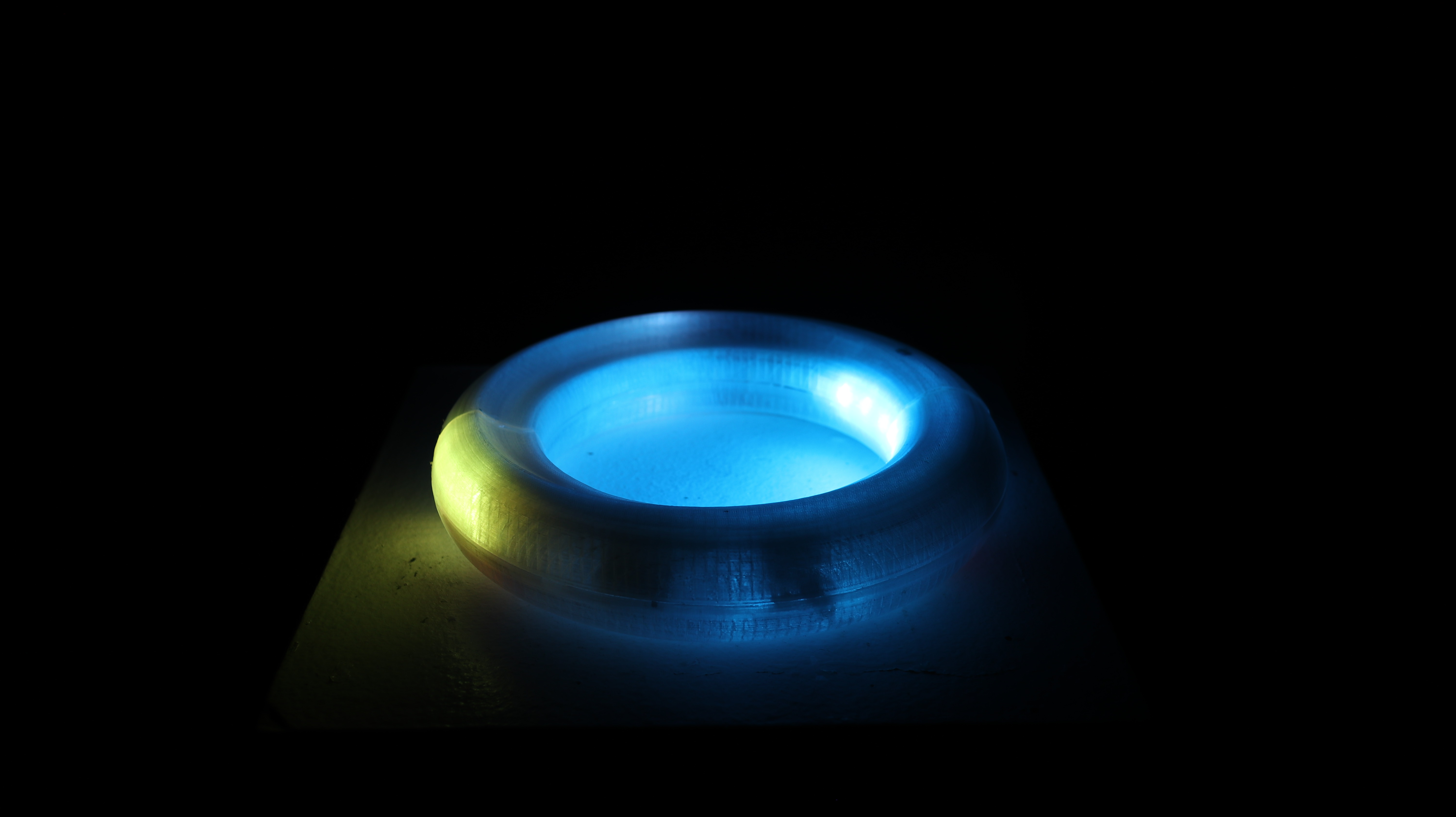
The device includes GPS, ESP32, a magnetometer (BMM150), a gyroscope (MPU6050), a potentiometer, dual LED rings, and a multi-layer PLA structure. Together, these components enable real-time solar azimuth calculation, orientation detection, visual mapping, and interval-timing calibration.
Mode 1 — Loading & Positioning
LEDs display flowing animations while the system retrieves GPS and solar data.
Mode 2 — Orientation Calibration
Real-time solar azimuth is mapped onto the LED rings as the astronaut moves the device, aligning light direction with the sun.
Mode 3 — Time Interval Recording
Astronauts rotate the knob to mark perceived start and end points of a time interval; the device computes and visualizes the time-perception error.
Across three major iterations, the system evolved from a basic LED matrix to a fully integrated ring with upgraded BMM150 sensors for higher precision. The final 24 cm outer ring and 16 cm inner opening were ergonomically optimized for handheld, floating usage in microgravity.
How can interaction restore our natural perception of time in extreme environments?