
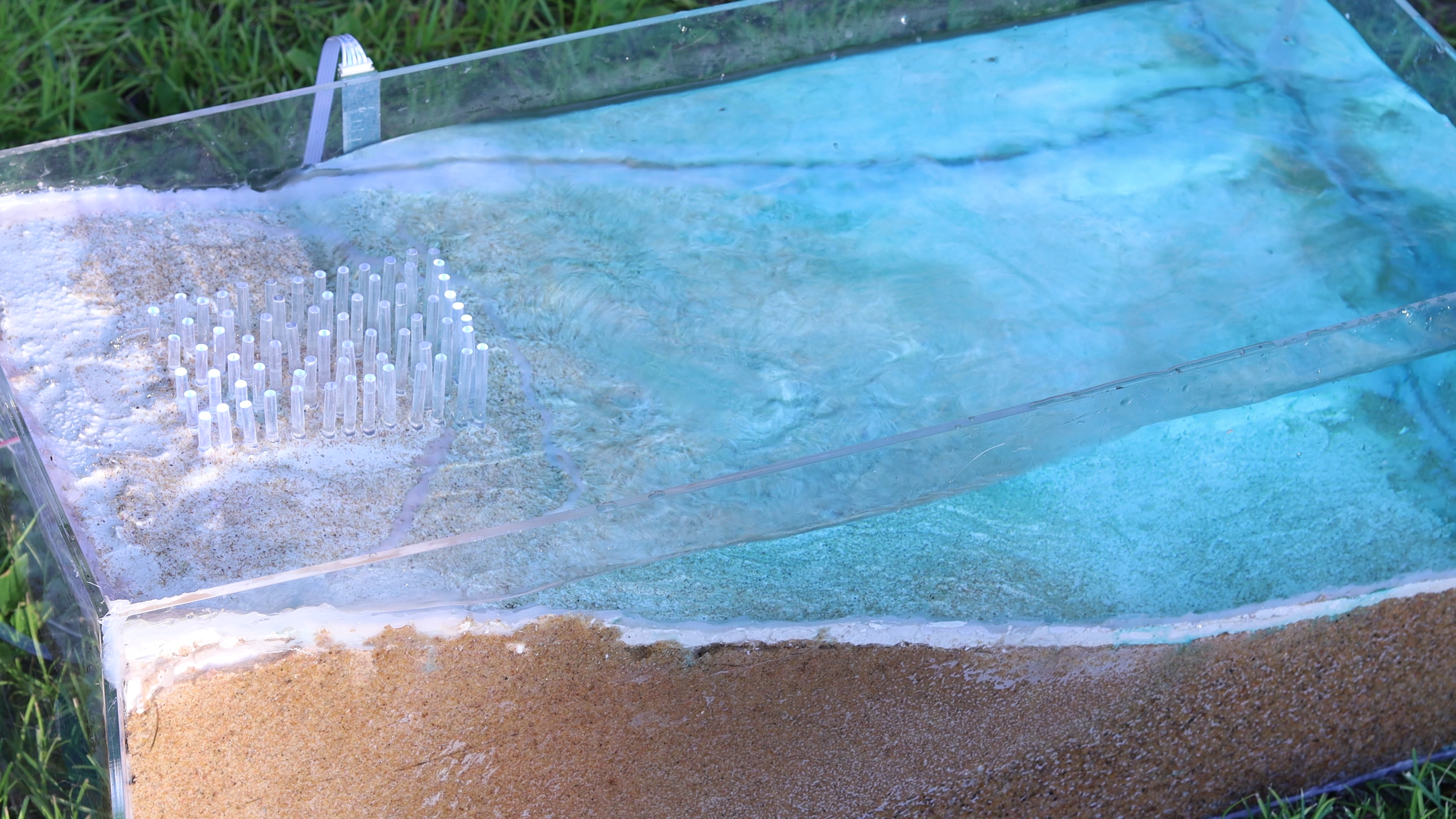
TideEcho is an interactive installation that visualizes rising sea levels, global warming, and the intensification of ocean waves. Placed in shallow coastal waters, it uses a 7×10 matrix of light columns to simulate three dynamic interaction states—normal tide, extreme tide, and human–nature interaction. Through shifting light patterns and environmental responsiveness, TideEcho encourages visitors to reflect on climate change and humanity’s role in ecological balance.


Over the past century, sea levels have risen by 8–9 inches, and projections estimate an increase of 1–8 feet by 2100. Statistical data shows a strong positive correlation between sea level rise and both global CO₂ emissions and temperature increases. These changes threaten ecosystems, infrastructure, and coastal communities worldwide.
TideEcho translates tidal data and climate patterns into light-based expression. The installation’s 70 interactive light columns act as a metaphorical ocean surface, where rhythm, intensity, and color shifts reflect nature’s harmony—or its disruption under human-driven climate impact.
Normal Ocean Mode
Soft, warm gradients simulate natural tidal rhythms and equilibrium. The gentle pulsing represents an undisturbed marine environment.
Extreme Ocean Mode
Rapid, high-contrast lighting symbolizes rising sea levels, storm surges, and ecological instability—evoking urgency and climatic tension.
Human Interaction Mode
Light responds to human touch with heartbeat-like pulses, emphasizing humanity’s subtle yet powerful influence on ecological systems.
A scaled-down prototype was created using a water tank to simulate real ocean conditions.
Components include:
- Acrylic tank for water simulation
- Optical fibers as light columns
- LED matrix, temperature sensor, water-level sensor
- Arduino-controlled system for signal processing
- PVC foam + sand cement layers to mimic shoreline topography
Optical fibers were selected for their waterproof properties and excellent light transmission, ensuring realistic representation of tide-driven lighting effects.
The system processes environmental inputs—temperature changes, water-level fluctuations, and manual wave creation—to generate dynamic LED lighting cycles.
Pipeline:
Temperature → Wave Generation → Water Level Sensing → Analog–Digital Conversion → LED Lighting Output
This creates synchronized rhythms of wave crest, fall, and return.
How can interaction deepen our awareness of nature’s dynamic changes?